Spatial Justice: Designing Spaces for Citizen Participation
Spatial Justice translates into Spanish as justicia espacial. This concept focuses on how the organization, design, and use of space affect people’s opportunities to participate fully in social, economic, and political life. Spatial justice addresses not only the equitable distribution of physical resources, such as access to infrastructure, but also the power to make decisions about the use and design of those spaces.
Have you noticed that, when a Citizens’ Assembly is convened, we almost always end up in spaces that seem designed for anything but dialogue? It might be a parliamentary chamber, with its solemn and intimidating layout, or an institutional hall where hierarchies are palpable in every corner. These places do not reflect the diversity or creativity of the people who occupy them, even if only temporarily.
But, what if deliberative spaces could be different? What if, instead of us adapting to them, politicians were the ones adapting to our needs? Imagine a setting where chairs can be moved to create circles of dialogue, where the walls tell stories of those who have participated before, and where every corner invites people to share ideas. Spaces that aren’t just cold copies of institutional ones, but a living reflection of the creativity and capacity for dialogue that we, as citizens, possess.
Greater participation by diverse communities
Ability to replicate the model
Improved Perception of Accessibility and Belonging
Design and Implementation of Inclusive and Functional Spaces
Our 360° holistic approach ensures that the design of the space is fully aligned with the principles of design justice: that it be inclusive, participatory, and transformative. Whether in citizens’ assemblies, community spaces, or digital platforms, we work to ensure that deliberative environments not only reflect the diversity of their users but also empower them to imagine and build a more just future.
We believe that both the physical space and the methods used to design it should reflect and enhance diversity, equity, and people’s creative potential. In this way, we bridge the gap between the design of the space and the ways in which it fosters (or limits) dialogue and collaboration.
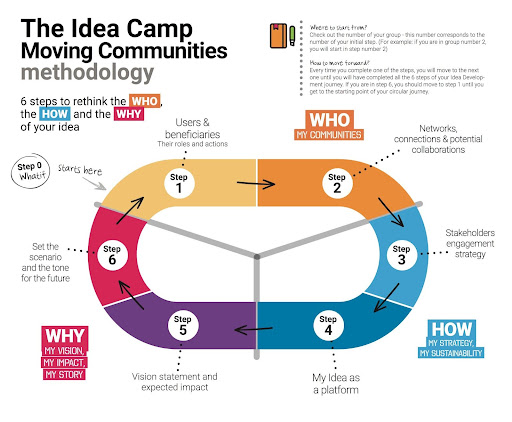
IdeaCamp: A three-day festival that helped 50 ideas become 50 projects. The facilitator training we conducted was designed to prepare partners from the other hubs to co-facilitate the methodological sessions with us.